Welcome to Myedrawings.com - industrial CAD files and equipment

Jul 05, 2026 / By MyeDrawings / in Workshop & Equipment
SLV2 stacks two scissor stages vertically under one platform. The idea is simple and widely used by European makers such as EdmoLift: keep a compact base footprint while reaching travel heights that a single-scissor table cannot deliver without an impractically long platform.
| Model | Capacity | Stroke | H MIN |
|---|---|---|---|
| SLV2-1000 | 1000 kg | 1600 mm | 320 mm |
| SLV2-2000 | 2000 kg | 2200 mm | 400 mm |
| SLV2-3000 | 3000 kg | 3000 mm | 450 mm |
Drawing: first-angle projection (ISO). Dimensions nominal.
Why vertical double exists
Single-scissor geometry ties stroke to platform length. When the process needs more height — mezzanine handoffs, tall packing cells, or stacking — stretching an SLX usually fails mechanically or commercially. A vertical double adds a second X-stage on top of the first, so stroke grows without forcing the deck to become a long-load table. EdmoLift’s double/triple ranges, for example, push lift strokes well into the multi-metre zone on standard platform lengths where a single stage would stop far earlier.
| Model | Capacity | Stroke | H MIN |
|---|---|---|---|
| SLV2-1000 | 1000 kg | 1600 mm | 320 mm |
| SLV2-2000 | 2000 kg | 2200 mm | 400 mm |
| SLV2-3000 | 3000 kg | 3000 mm | 450 mm |
Drawing: first-angle projection (ISO). Dimensions nominal.
The closed-height trade-off
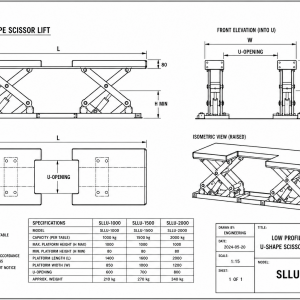
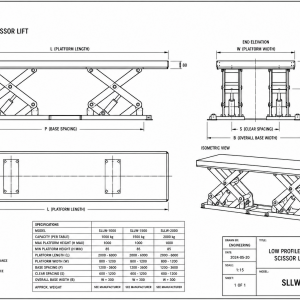
Every extra stage adds structure when the table is fully lowered. Typical double-scissor closed heights sit higher than comparable single-scissor models (often in the few-hundred-millimetre band rather than the lowest single-stage packages). That matters if you planned floor-level trolley loading without a pit. If H MIN must stay very low, SLV2 is the wrong family — look at low-profile SLL / SLLW / SLLU instead, or accept a pit for the high-lift unit.
| Model | Capacity | Stroke | H MIN |
|---|---|---|---|
| SLV2-1000 | 1000 kg | 1600 mm | 320 mm |
| SLV2-2000 | 2000 kg | 2200 mm | 400 mm |
| SLV2-3000 | 3000 kg | 3000 mm | 450 mm |
Drawing: first-angle projection (ISO). Dimensions nominal.
Capacity, stiffness, and duty
Rated capacity still assumes sensible load placement, but stacked scissors increase the importance of guidance, cylinder synchronisation, and structural stiffness. European catalogues often offer heavy-duty variants for intensive cycles. Brief the duty cycle (lifts per hour), whether the platform carries fixtures or conveyors, and whether operators travel with the load. Those points change guarding, hose-burst protection expectations, and whether EN 1570-1 alone covers the installation or fixed-landing rules become critical.
| Model | Capacity | Stroke | H MIN |
|---|---|---|---|
| SLV2-1000 | 1000 kg | 1600 mm | 320 mm |
| SLV2-2000 | 2000 kg | 2200 mm | 400 mm |
| SLV2-3000 | 3000 kg | 3000 mm | 450 mm |
Drawing: first-angle projection (ISO). Dimensions nominal.
Stroke planning for SLV2
Define the lowest working height and the highest transfer height, then convert to stroke. Do not buy “as much stroke as possible” by default: unused travel adds closed height, mass, lift time, and cost. Compare lift times in supplier data — double-stage tables often take longer to reach top height than an SLX of similar capacity, which affects takt time on automated or high-throughput lines.
| Model | Capacity | Stroke | H MIN |
|---|---|---|---|
| SLV2-1000 | 1000 kg | 1600 mm | 320 mm |
| SLV2-2000 | 2000 kg | 2200 mm | 400 mm |
| SLV2-3000 | 3000 kg | 3000 mm | 450 mm |
Drawing: first-angle projection (ISO). Dimensions nominal.
When to choose SLV2 vs SLV3 or SLX
Choose SLV2 when single-stage stroke is short, the footprint must stay compact, and closed height can tolerate a taller collapsed package. Move to SLV3 when the upper landing or work cell is still out of reach after a realistic double-stage package. Stay on SLX when travel is moderate and you want the simplest, lowest, and usually fastest everyday table. Choose SLH2 only when the problem is platform length and load distribution, not vertical reach.
| Model | Capacity | Stroke | H MIN |
|---|---|---|---|
| SLV2-1000 | 1000 kg | 1600 mm | 320 mm |
| SLV2-2000 | 2000 kg | 2200 mm | 400 mm |
| SLV2-3000 | 3000 kg | 3000 mm | 450 mm |
Drawing: first-angle projection (ISO). Dimensions nominal.
Brief checklist for an SLV2 drawing
1) Required H MIN / H MAX and whether a pit is allowed
2) Rated load, centre of gravity, and any deck-mounted equipment
3) Platform L × W constrained by the cell, not by wishful stroke maths
4) Lift time / duty cycle and power-pack location
5) Guarding, travel-zone risks, and EN 1570-1 use case (goods, operators, landings)
Clear answers here keep an SLV2 specification honest — high enough to do the job, without paying for a triple-stage machine you do not need.
| Model | Capacity | Stroke | H MIN |
|---|---|---|---|
| SLV2-1000 | 1000 kg | 1600 mm | 320 mm |
| SLV2-2000 | 2000 kg | 2200 mm | 400 mm |
| SLV2-3000 | 3000 kg | 3000 mm | 450 mm |
Drawing: first-angle projection (ISO). Dimensions nominal.
Jul 28, 2026 by MyeDrawings
Jul 23, 2026 by MyeDrawings